NS Documentation Centre Munich: The Free History Museum On Königsplatz
The NS Documentation Centre (NS-Dokumentationszentrum) on Max-Mannheimer-Platz near Königsplatz is the one Munich museum that deals directly with the city's Nazi past, and entry is free for everyone.
Short answer
Yes, the NS Documentation Centre Munich is free to enter for all visitors, with no tickets needed or bookable. It is open Tuesday to Sunday from 10:00 to 19:00. The Dachau Concentration Camp Memorial Site outside the city is also free, with daily English tours at 11:00 and 13:00.
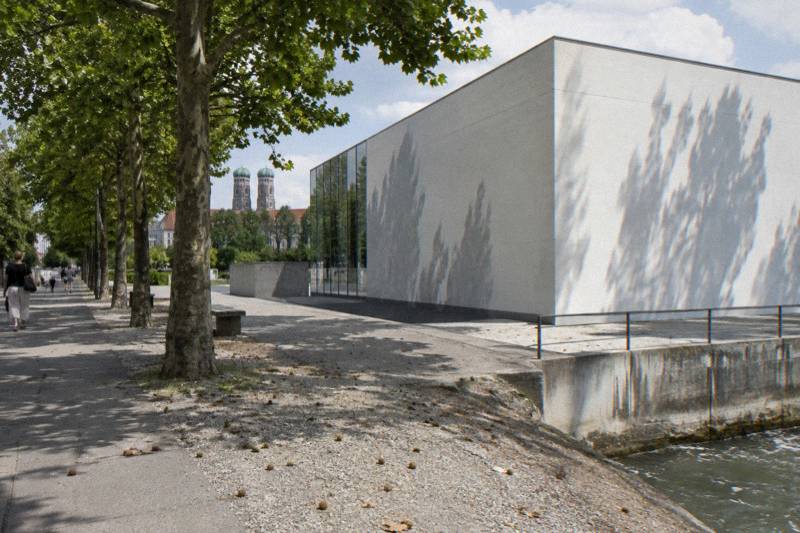
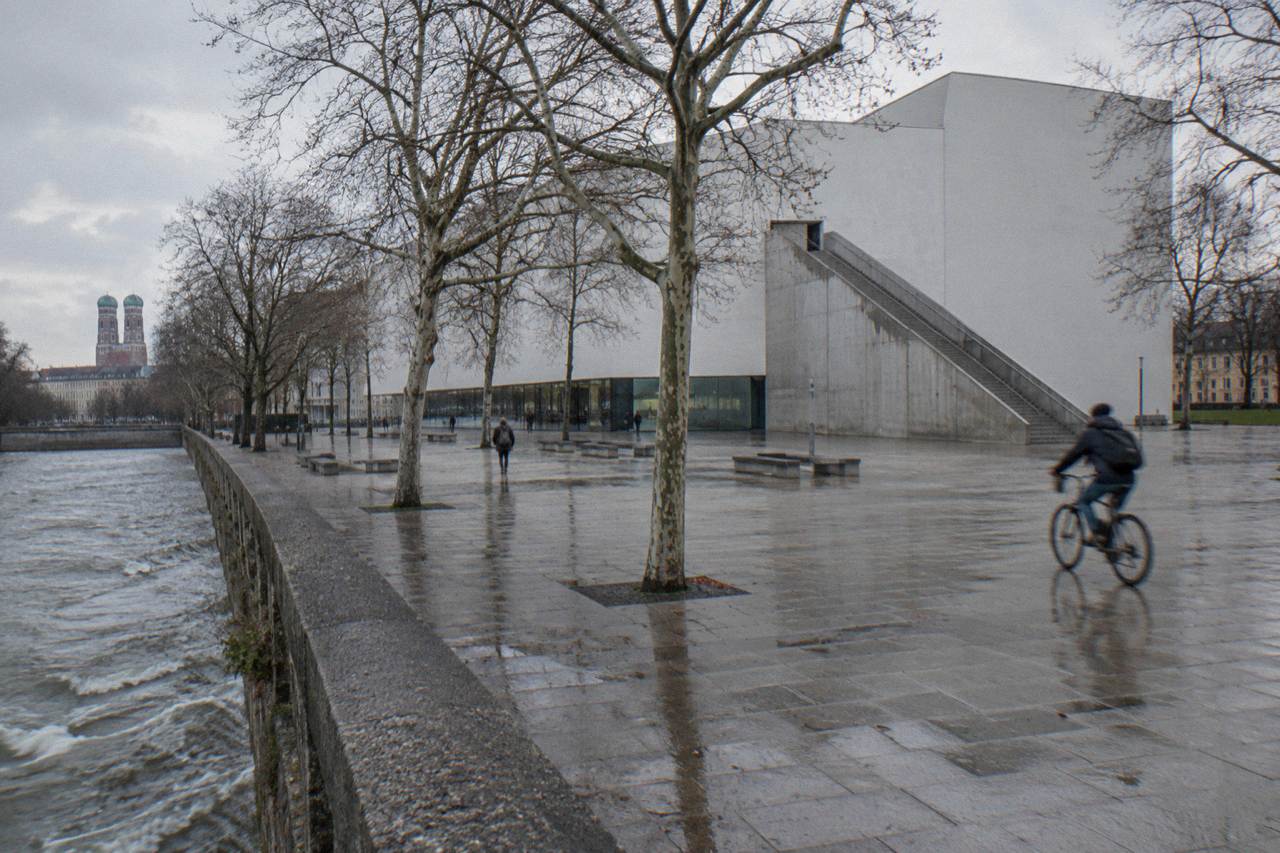
The NS Documentation Centre (NS-Dokumentationszentrum) stands on Max-Mannheimer-Platz at the edge of the Königsplatz, on ground the Nazi party once used for its own purposes. Munich was what the regime called the capital of the movement, and this building, a white cube with a stairway shaft cut through it, is the city's permanent examination of that history. The operator states it plainly on its own visit page: entrance is free of charge for all visitors, and no tickets are needed or bookable. That single fact makes it one of the most substantial free museum visits in Germany, and this guide covers what is inside, when to go, and the free walking tours that put the documents in context on the street outside.
Is The NS Documentation Centre Munich Free To Enter?
Yes, entry to the NS Documentation Centre Munich is completely free for every visitor. The centre's own visit page states that entrance is free of charge and that no tickets are needed or bookable. Opening hours are Tuesday to Sunday from 10:00 to 19:00, so plan around a Monday closure, and there is nothing to reserve or pay at the door.
That free admission is unconditional. There is no suggested donation gate, no reduced-rate half ticket, no free-hour window to hit. You walk in during opening hours and you walk the permanent exhibition, the learning centre and the study rooms without paying anything. The only things that can cost money are the special exhibitions and events the centre runs alongside its permanent display, which the operator prices individually, and the catalogue or bookshop purchases inside.
It is worth being precise about the name, because searches for a nazi documentation center munich turn up several different places. The Munich centre is on Max-Mannheimer-Platz, next to the Königsplatz in the Kunstareal museum district. Its full remit is the history of National Socialism in Munich specifically: how the movement took root here, how the city hosted its ceremonial spaces, and how Munich dealt with the legacy after the war ended. The documentation is in German and English throughout.
The location itself is part of the exhibit. The building occupies the site where the Nazi party once ran its administrative headquarters, the so-called Brown House, and the Königsplatz immediately beside it was paved over by the regime for mass rallies. Reading the exhibition and then stepping out onto that same square is the whole design of the place, and the square costs nothing either. Königsplatz is an open public space, freely accessible, though the two museums standing on it, the Glyptothek and the Staatliche Antikensammlungen, charge separately and are EUR 1 per house on Sundays.
The centre sits inside the Kunstareal, Munich's museum quarter, which means a visit can be combined with several other stops in a single walkable loop. For the practical details, the centre's own page is the source: the NS-Dok's general visitor information covers hours, access and current special exhibitions.
| Practical point | Detail |
|---|---|
| Entry | Free for all visitors, no tickets needed or bookable |
| Opening hours | Tuesday to Sunday, 10:00 to 19:00 |
| Closed | Mondays |
| Address | Max-Mannheimer-Platz, at the Königsplatz |
| Languages | German and English exhibition |
| Paid extras | Special exhibitions, events, bookshop |
What Will You See Inside The NS Documentation Centre?
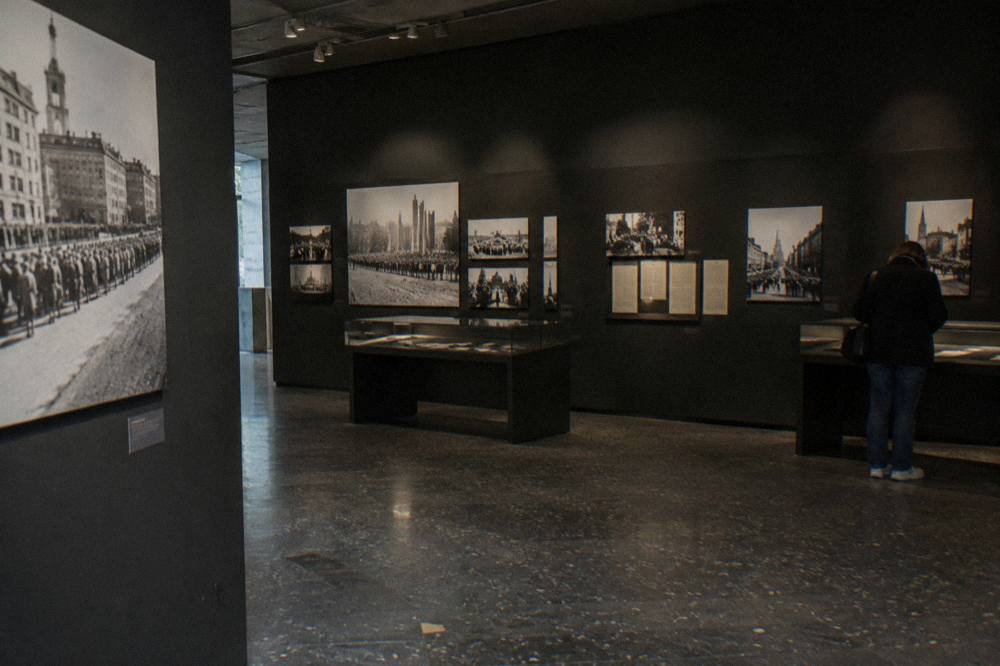
The permanent exhibition, titled Munich and National Socialism, fills four floors with documents, photographs, film and audio stations, all labelled in German and English. It traces the city's history from the end of the First World War through the Nazi rise, the regime's use of Munich, and the post-war reckoning. A learning centre and a library reading room complete the offer, all inside the free entry.
The exhibition works chronologically. It opens with Munich in the Weimar years, a city where the Nazi party was founded and where it found its early foothold, then follows the transformation of the city into the capital of the movement, with the Königsplatz and the surrounding Königsplatz area reshaped as ceremonial stone architecture. Photographs, newspaper clippings, membership cards and propaganda material carry the argument, and testimony from victims and from contemporary witnesses runs through the later rooms. The final section covers the post-war years onwards: denazification, the city's long silence about its role, and the eventual decision to build a documentation centre at all, decades after the war ended.
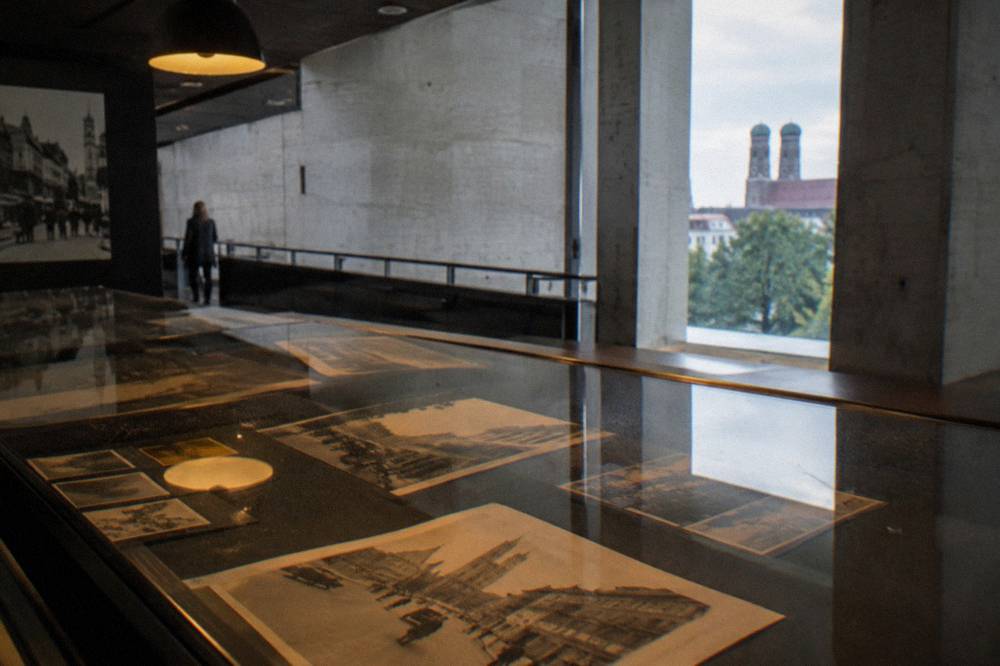
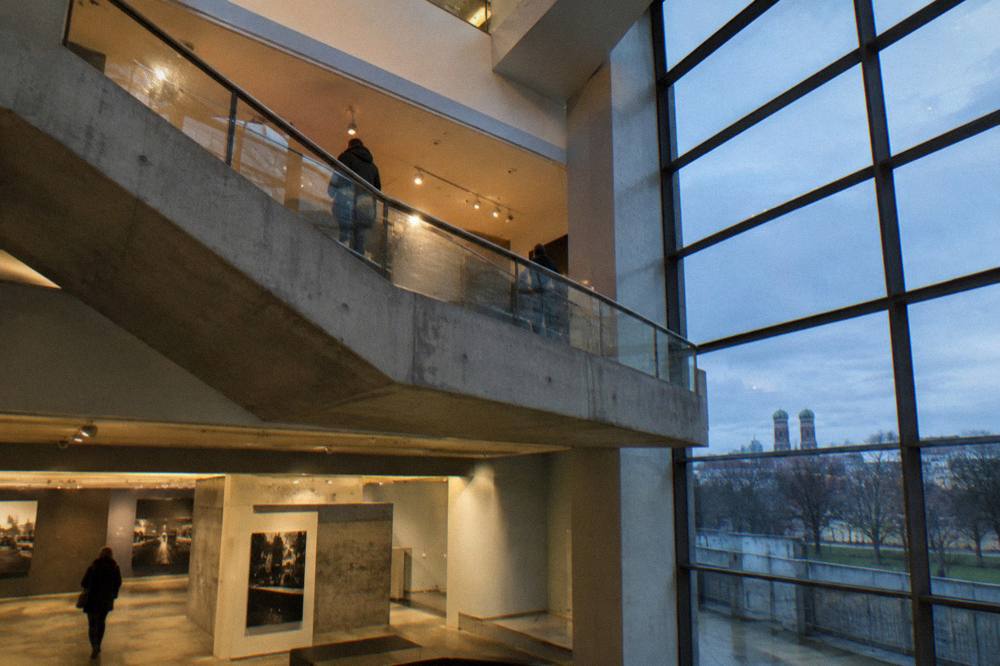
The building's architecture reinforces the content. The stairway shaft slices diagonally through the white cube, and the top floor's National Socialist history is deliberately left unfinished at the edges, a design choice meant to signal that this history is still being worked through rather than closed. From the upper levels the windows frame the Königsplatz itself, so the rally ground the documents describe is visible while you read.
Allow a solid block of time. The permanent exhibition is dense, and visitors who read seriously rather than skimming spend several hours. Because entry is free, you can also split the visit: walk the top floors one morning, come back another day for the rest, and pay nothing either time. The special exhibition space and the events programme are where the operator charges, so check what is on when you plan.
Visitors with a research interest can use the library reading room on the same free terms.
The centre is not the only free documentation offer in the city. The interim exhibition of the Munich City Museum is free while its main building stays closed, and the memorials landscape is set out further down this guide. For a full rundown of every museum with a free angle, see the companion guide to free museums in Munich.
Which Free Third Reich Walking Tours Complete The Visit?
Yes, and they pair naturally with the centre: free, pay what you want walking tours covering Munich's Third Reich history run on GuruWalk, including the English Third Reich, Three Hours walk by Walkative! Tours, rated 4.89 out of 5 across 36 GuruWalk reviews. It meets at St Peter's Church and runs three hours, free to reserve with no upfront payment.
The English Third Reich, Three Hours walk is the English-language option in the third-reich category. Walkative! Tours runs it as a GuruWalk listing, it meets at St Peter's Church in the old town, and it lasts three hours, the longest duration on this site's roster. Old Town Intro, which is rated 4.82 out of 5 across 686 GuruWalk reviews.
The Spanish-language options go deeper into the same ground. The Spanish Nazism Tour, Three Hours by Destino Munich, rated 4.95 out of 5 across 554 GuruWalk reviews, meets at Marienplatz, and Explora Múnich runs the Spanish Third Reich Origins Walk, rated 4.82 out of 5 across 213 GuruWalk reviews, meeting at the Fischbrunnen on Marienplatz. All of them are free, pay what you want, reserved through their GuruWalk pages.
If the history of the Nazi era is heavy going for younger travellers or you simply want a lighter frame first, the classic old town walks give you the city's whole story rather than its darkest years alone, and they cover some of the same streets.
The Fun English Old Town Walk by Heart of Munich Tours is listed on freetour.com, rated 9.7 out of 10 across 1,205 freetour.com reviews, and runs two and a half hours in English from Marienplatz. The Two-Hour English Stroll by Patrick, a GuruWalk walk rated 4.94 out of 5 across 816 GuruWalk reviews, meets at Viscardigasse. Every walk across both platforms, the whole roster of 18 free walking tours this site catalogues, works the same way: free, pay what you want, reserved on the platform the walk runs on.
How Does The Centre Compare With The Dachau Memorial?
The two are complementary, not competing. The NS Documentation Centre covers how the Nazi movement took power in Munich itself, while the Dachau Concentration Camp Memorial Site, outside the city, preserves the camp ground itself. Both are free to enter; Dachau is open daily 9:00 to 17:00, with free daily English tours at 11:00 and 13:00.
The memorial's own page states free entry, daily opening from 9:00 to 17:00, closure on 24 December, and the former crematorium area closing at 16:30. The guided tour price and booking requirement are not settled on an official page, so treat the daily 11:00 and 13:00 English tour times as the confirmed fact and check the memorial's own site for anything beyond that. The audio guide is a paid layer at EUR 5, reduced EUR 4. For the full picture, including how to get there and what is open, read the dedicated guide to Dachau memorial visiting.
A sensible split for a history-focused trip is one half-day at the NS Documentation Centre, reading how Munich built the movement, and one full day at Dachau, standing where its consequences ended. Doing the centre first gives the camp its context. Both fit a zero-euro budget, which is unusual for a pair of sites of this weight: the details are confirmed on the centre's visit page and on the Dachau memorial's official site.
| NS Documentation Centre | Dachau Memorial | |
|---|---|---|
| Entry | Free, no tickets | Free |
| Opening | Tuesday to Sunday, 10:00 to 19:00 | Daily 9:00 to 17:00 |
| Location | Max-Mannheimer-Platz, Munich | Outside the city, a day trip |
| Language | German and English exhibition | German and English, daily English tours 11:00 and 13:00 |
| Paid layer | Special exhibitions and events | Audio guide EUR 5, reduced EUR 4 |
| Closed | Mondays | 24 December |
What Else Is Free Nearby In Munich?
A lot. The Königsplatz outside the centre is an open public square, the Hofgarten beside the Residenz is free, and the Olympiapark grounds with the Olympiaberg hill are open public space. The Frauenkirche, St Peter's Church and the Asamkirche have free interiors, while their towers are paid climbs, and the Marienplatz Glockenspiel plays free to watch at 11:00 and 12:00 daily.
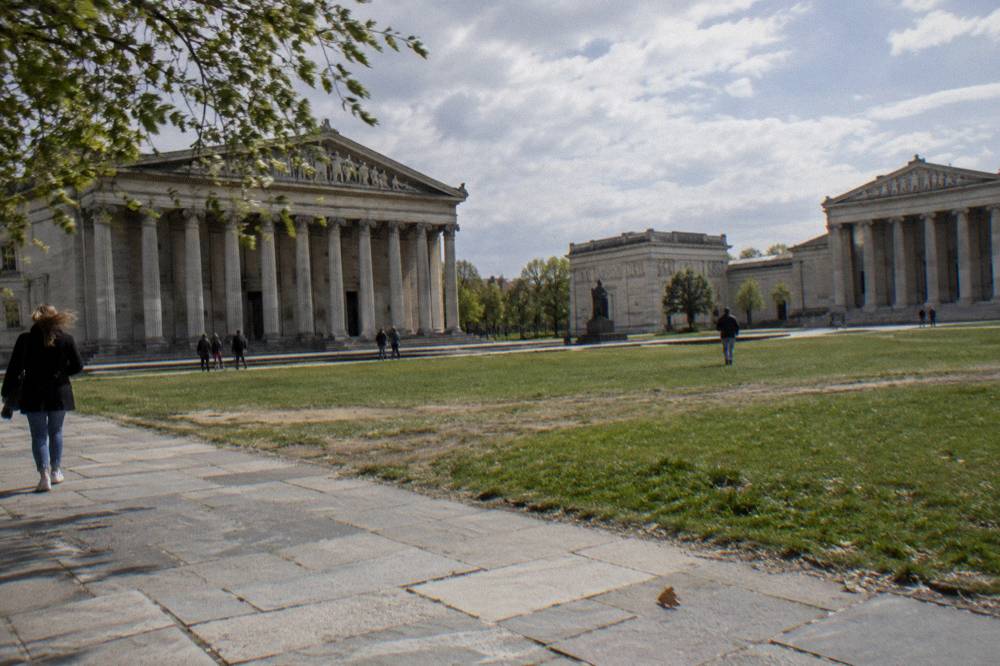
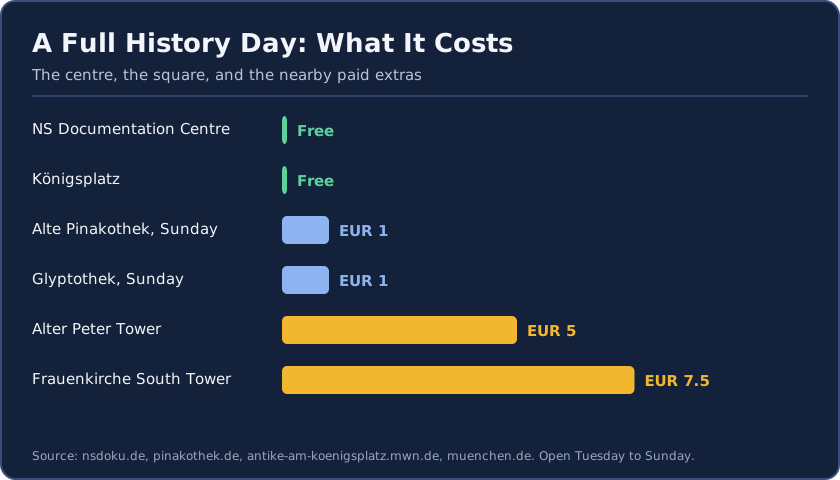
Start on the doorstep. Königsplatz is free to walk, a broad neoclassical square framed by the Glyptothek and the Staatliche Antikensammlungen, both EUR 1 per house on Sundays and EUR 6 and EUR 4 respectively otherwise. Walk east from the old town and you pass the Odeonsplatz and Feldherrnhalle, an open public square and loggia with no admission, and the Hofgarten, whose operator, the Residenz administration, states plainly that the Hofgarten and Brunnwerk are free while the Residenz museum, treasury and theatre next door are ticketed. The full split is in the guide to the Residenz and the free Hofgarten.
The churches follow the church-free-tower-paid pattern that trips up a lot of visitors. The Frauenkirche interior is free while the south tower climb is EUR 7.50; St Peter's Church is free while the Alter Peter tower costs EUR 5; the Asamkirche is simply free. The Rathausturm lift at the New Town Hall is ticketed, but the Glockenspiel below it is free to watch from Marienplatz, playing at 11:00 and 12:00 daily, with the 17:00 show only from March to October, so the evening performance is off in the November to February window.
| Free nearby | What is free | What is paid |
|---|---|---|
| Königsplatz | Walking the square | Glyptothek and Antikensammlungen, EUR 1 per house on Sundays |
| Hofgarten | The whole garden | Residenz museum, treasury, theatre |
| Frauenkirche | Church interior | South tower, EUR 7.50 |
| St Peter's Church | Church interior | Alter Peter tower, EUR 5 |
| Marienplatz | The square and the Glockenspiel | Rathausturm lift |
| English Garden | 376 hectares, open all year | Nothing for entry; food and drink in the beer gardens |
The English Garden deserves its own half day: 376 hectares, open all year, entry free, with the Eisbach wave viewable free from the bank, surfing allowed again since 8 May 2026 under an amended city order, and the Monopteros hill viewpoint reachable at any time. The Chinese Tower beer garden sits inside the garden with around 7,000 seats; entering costs nothing, the beer does. Further afield, the Olympiapark grounds and the Olympiaberg hill viewpoint are open public space, while the Olympic Tower and the stadium tours inside the park are ticketed, and BMW Welt is free while the BMW Museum opposite it is paid. Nymphenburg works the same way as a pair of facts: the operator's admission page lists no ticket for the park itself, while the palace, the Marstallmuseum and the Parkburgen are paid, and the Parkburgen are closed in winter.
One budget tip worth planning around: Munich's transport authority sells a valid ticket that doubles as a discount pass at some museums, so hold onto it after you ride. The same goes for proof of age, since several admission schemes across the city give reduced or free entry to visitors under 18 or over 65, and students with valid ID often pay less as well. If you are visiting several paid institutions in one trip, ask at each ticket counter whether a combined or day ticket exists before buying separately, as the savings can cover a meal.
Timing matters as much as the ticket price. The Glockenspiel performance lasts around 15 minutes, so arrive a few minutes early for a good spot on Marienplatz, and in the warmer months the square fills up fast. For the churches, interiors are working places of worship, so quiet visiting during service hours is expected, and a short stop at the Asamkirche, small and dark and dense with decoration, is one of the most concentrated free sights in the old town.
When Is The Best Time To Visit The NS Documentation Centre?
The NS Documentation Centre is open Tuesday through Sunday from 10:00 to 19:00, closing only on Mondays, so any day except Monday works equally well for a visit. Because hours stay constant throughout the week, your choice can simply depend on which day fits your travel schedule best, making it easy to plan around the museum's reliable Tuesday to Sunday opening hours.
Late opening to 19:00 is the practical advantage. The Pinakothek museums around the Königsplatz and most of the Kunstareal shut earlier in the afternoon, so the NS Documentation Centre can be the second stop of a museum day rather than the first. Pair it with the EUR 1 Sunday scheme at the state museums: a Sunday that starts at the Alte Pinakothek or Museum Brandhorst for EUR 1 can end at the centre for nothing, a full museum day in the Kunstareal for the price of a coffee.
Season matters less here than for outdoor Munich, which is exactly why the centre earns its place on a winter itinerary. The Christmas season is the live angle from late November: the Christkindlmarkt at Marienplatz runs 20 November to 24 December 2026, the Tollwood Winter Festival runs 24 November to 23 December 2026 on the Theresienwiese with free grounds and a free Market of Ideas, and all Munich Christmas markets are closed for the day on Totensonntag, 22 November 2026. A cold, dark December afternoon sits well inside a history museum, with the markets afterwards. The seasonal picture is laid out in the guide to Munich's Christmas markets.
One planning note on language: the exhibition is fully bilingual German and English, so English-speaking visitors lose nothing. Tours.
For travellers mapping a whole low-spend stay around sites like this, the companion guide to Munich on a budget collects the free parks, squares, churches and museum schemes in one place, and Free Things To Do In Munich is the site's home for all of it.
If the architecture angle of the Königsplatz area interests you as much as its history, the architecture and hidden gems walks run from the same district, all free, pay what you want.
Common Questions About The NS Documentation Centre Munich
Is The NS Documentation Centre Munich Free To Enter?
Yes. Entrance is free of charge for all visitors, and no tickets are needed or bookable. It is open Tuesday to Sunday from 10:00 to 19:00 and closed on Mondays.
Where Is The Nazi Documentation Center In Munich?
It is at Max-Mannheimer-Platz, at the edge of the Königsplatz in the city's Kunstareal museum district, on the site of the former Nazi party Brown House headquarters.
How Long Does A Visit To The NS Documentation Centre Take?
The permanent exhibition, Munich and National Socialism, fills four floors, and a serious visit runs several hours. Because entry is free, you can also split it across two visits without paying.
Is The NS Documentation Centre In English?
Yes, the permanent exhibition is labelled in both German and English, including documents, photographs, film and audio stations.
Is The Dachau Memorial Also Free?
Yes, the Dachau Concentration Camp Memorial Site is free to enter and open daily 9:00 to 17:00, closed 24 December. Daily English tours run at 11:00 and 13:00; the audio guide at EUR 5, reduced EUR 4, is the paid layer.
Are There Free Walking Tours Of Munich's Third Reich History?
Yes. The English Third Reich, Three Hours walk by Walkative! Tours, rated 4.89 out of 5 across 36 GuruWalk reviews, runs in English from St Peter's Church, and Spanish-language GuruWalk walks cover the same ground, all free and pay what you want.